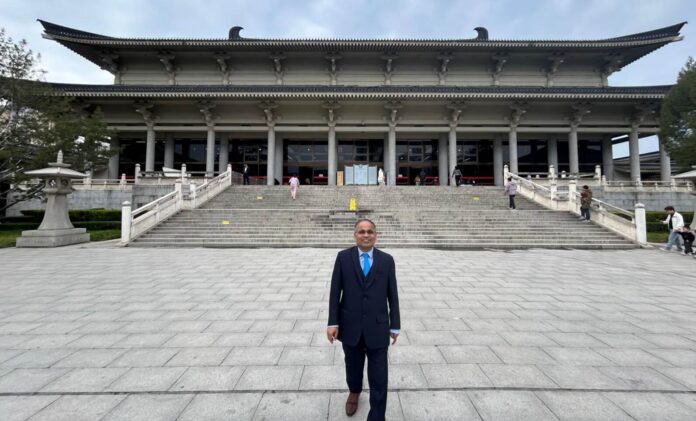
Bikash Pal: Having finished my official engagement at Xi’an, I ventured into the city. Xi’an is one of the five most ancient cities in the world with a rich heritage spanning over 3000 years. It was the first city in the world’s history to have one million people. Xi’an is at the eastern front of the ancient Silk Route passing through central Asia to as far west as Italy and down south to the Middle East and the Indian subcontinent.
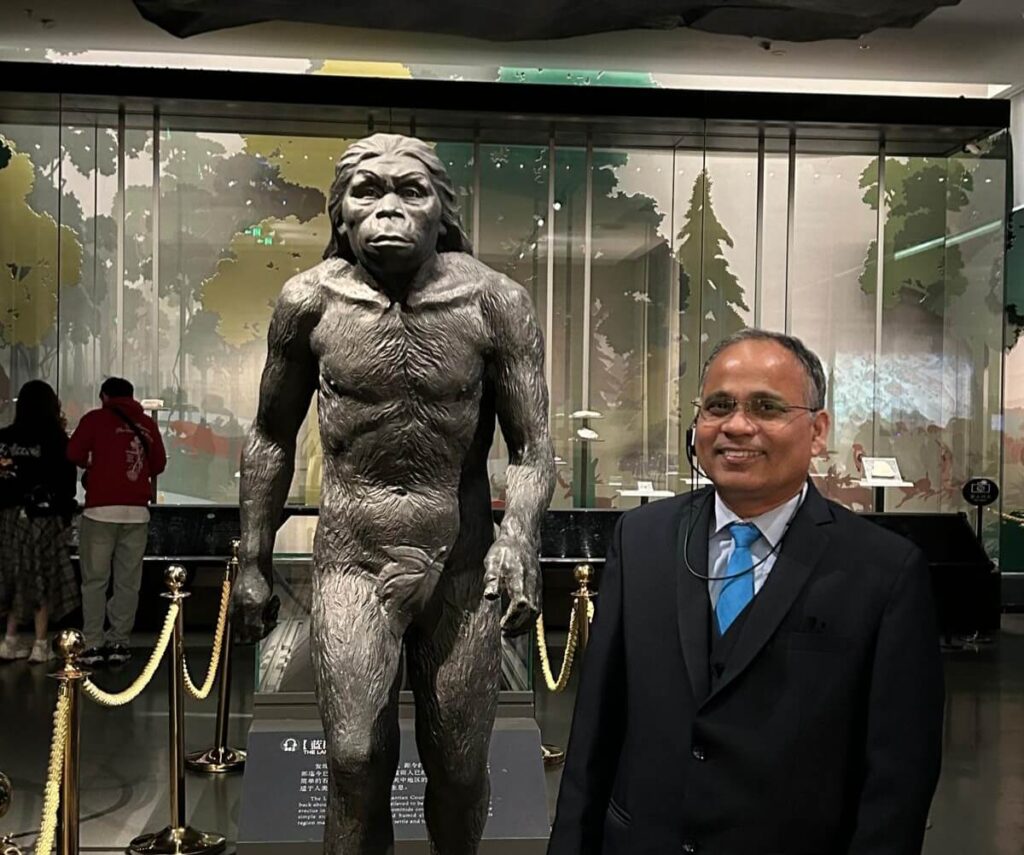
A Lantian man with flat skull with thick wall housing a relatively small brain volume. This is from prehuman times. This man lived in this valley.
Shaanxi is a province in the Wei river valley, very fertile and very green. The river Jing meets the river Wei at Xi’an – then takes the name of Hwang-Ho, the river of the sorrows and separations for the ordinary Chinese. Hwang-Ho flows further towards the east to meet the Yellow sea.
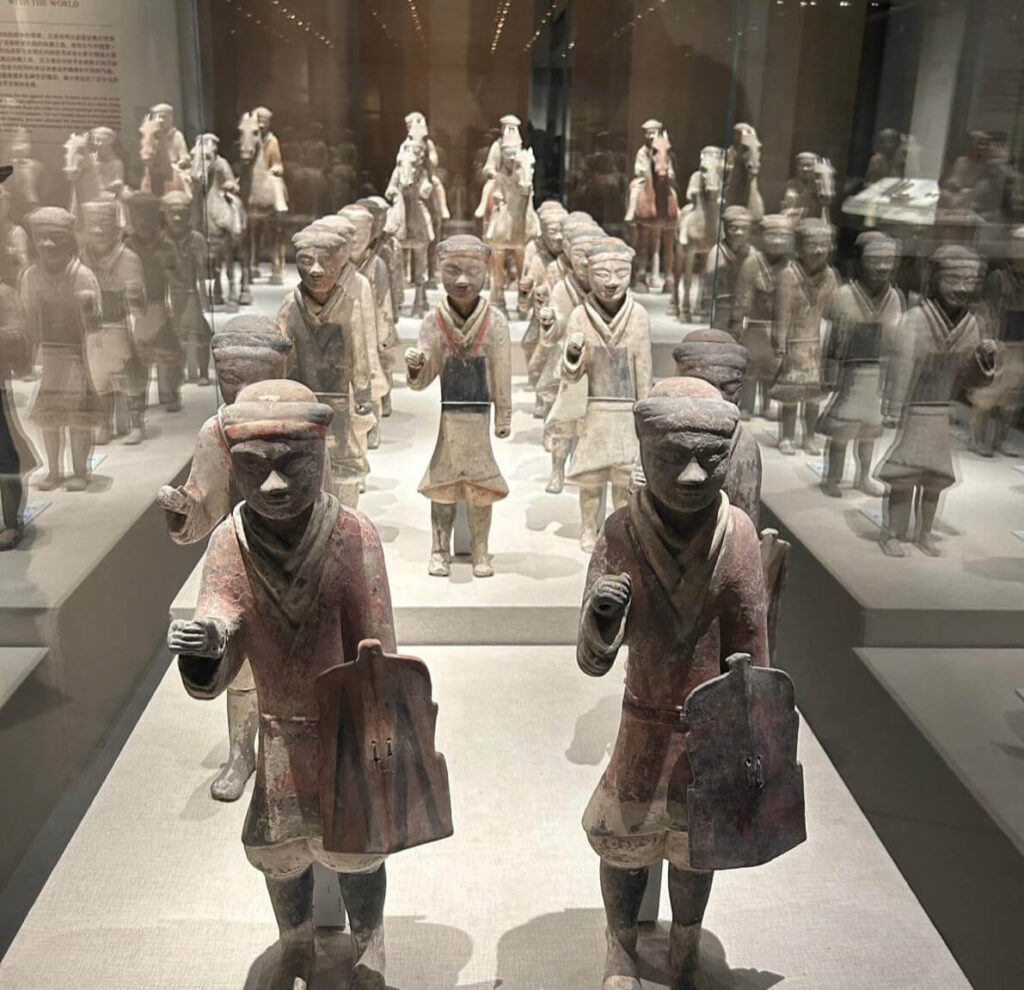
As has happened with all the civilizations from the rest of the world, this one in the Wei Valley was no different . This too has progressed through ups and downs over thousands of years. Yet people’s life moved on. As many as 13 dynasties governed China for over 3000 years from Xi’an.
A 2:30 hrs tour was arranged by my old friend Zaohong with an English tour guide. The museum has over 1.7 millions artifacts demonstrating how people’s life progressed with times. I was taken to four sections : the times of the Zhao , Qin , Han and the Tang dynasty. There is so much to see , but I had so less time.
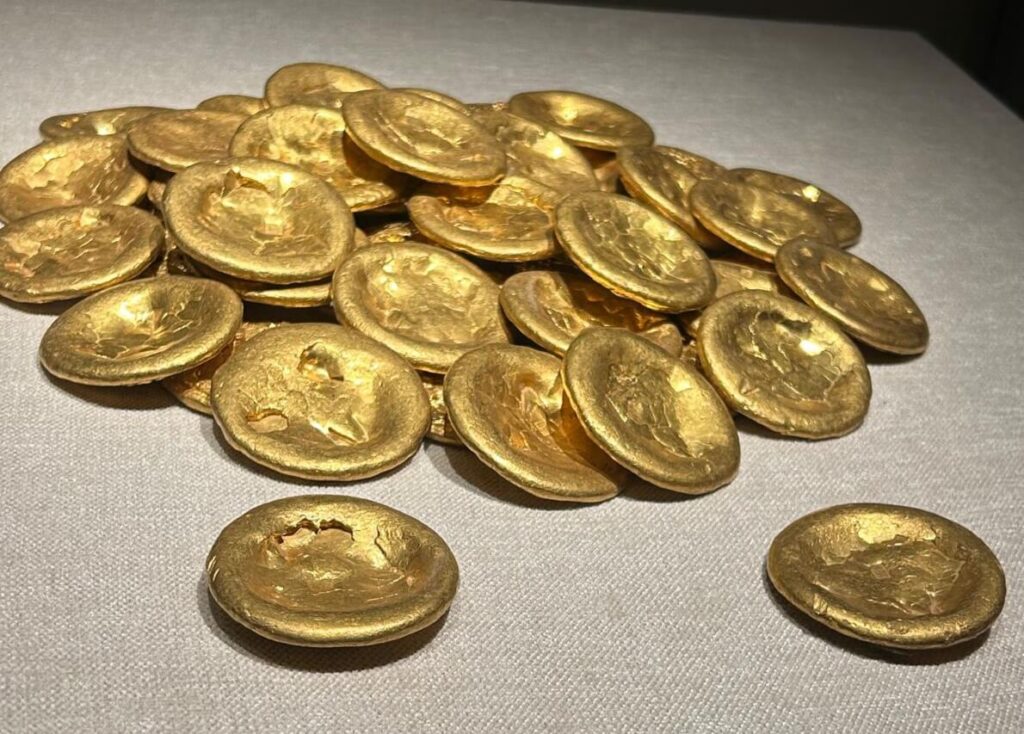
Gold coins used during the times of the Han dynasty
Tea pot from the times of the Qin (200 BC). My tour guide explained the engraved dancing horse on the tea pot had Persian art all over. I could also relate from my past learnings . It is a demonstration of the fact that the Qin emperors were open to exchange of arts and crafts with the contemporary civilizations prevalent elsewhere. One fascinating object that can be seen is a stylish cup in the mouth of the dancing horse . The emperors were connoisseur of dance and music. Perhaps they were not happy with the quality of the dances from men women at times. So the horses used to offer more satisfaction to them in the royal music room. They could even serve drinks to the emperors during the dance, so a cup in their mouth.
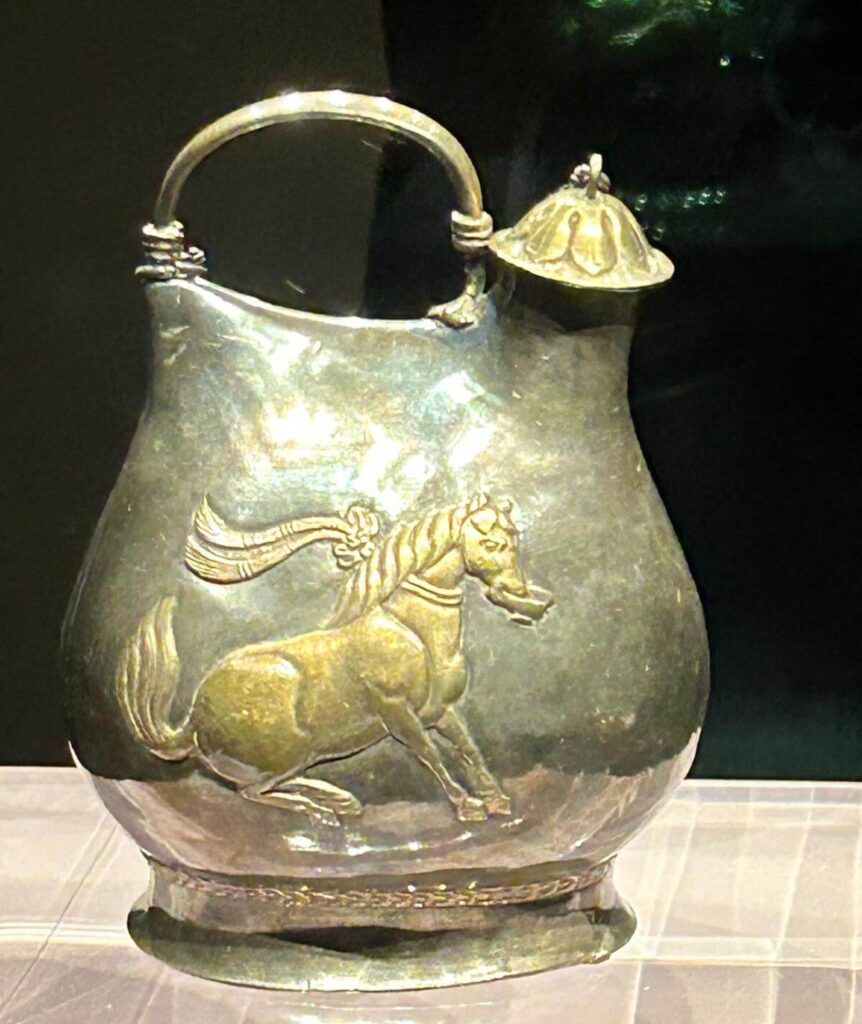
Tea pot from the times of the Qin (200 BC).
It was a fantastic time in the museum that was followed by a memorable dinner with the musicals . The food and music reflected the test of those of The Tangs (600-900 AD), the last major dynasty to govern China from Xi’an.
My friend Zaohong joined me at the venue after her long day at the office. The musical presented the life and work of Empress Wu , the only empress in Chinese history. It was presented by famous Shaaxi opera. During her time, the Tang dynasty was expanded most: Zhijiang from the west to North Korea to the east, Inner Mongolia in the north to the Vietnam to the south. That was the most happy and prosperous time in Tang dynasty.
After dinner, Zaohong saw me off in the car with her colleagues. I returned to my hotel with so happy experience in life. I will remain ever grateful to her hospitality. She sent her secretary to escort me from Southwestern city of Chengdu to Xi’an. I could not be more thankful to my life to be treated so well by the Vice President of a major Chinese university with over 50000 students and 6000 staffs, who are working very sincerely and very hard day in day out to further the progress of their motherland.
Today is another day for me to travel to Taiyuan, a province in the Central China. It is about 650 km journey by fast train. My another old friend Hongbin (now the serving President of Taiyuan University) has very thankfully sent his colleague to escort me to his city.
It is time to finish this travelogue and enjoy the mountainous landscape through the windows from the train. All keep well.
Bikash Pal
31st March
On the way to Taiyuan from Xi’an.